Essen

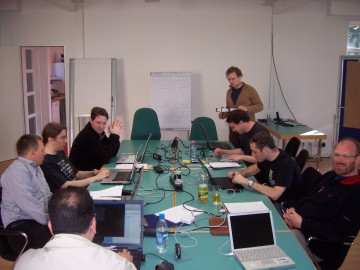
Lots of developers at the linuxhotel in Essen, Germany for the developer weekend.


Right now it’s Saturday morning and we’re making a quick mind map of people and interests.

More as the weekend continues… I didn’t get round to updating this what with lack of connectivity these past few days so have a look at the results page

OpenStreetMap – Weekly Review

Lint is a tool that checks for errors in C code, taking its name from fuzzy fluff that accumulates around us, getting in our way and making us sneeze. Map’s have lint too; misplled tgs, orphan segments and untagged ways all cause problems when people want to use OSM’s data. Maplint does for OSM data what Lint does for C code, it looks at an OSM XML file and generates an error report, which can then be rendered by OSMarender, giving visual clues to the location of rogue data:


The Maplint Layer In InformationFreeway.org

With the extension of the Tiles@Home server to support multiple layers, Maplint reports can now be viewed at InformationFreeway.org. There’s also a plugin for JOSM – JosmLint – that will highlight potential errors whilst you are editing a map, which can be downloaded from here.

Wii have an interesting approach to mapping underground networks developing on the dev mailing list. GPS units are pretty lame underground, and there haven’t been many volunteers to survey the Blackwall Tunnel on foot. A solution being discussed at the moment is to use accelerometers to detect motion and produce a map, specifically the motion sensors that are integrated into the handset of the Nintendo Wii console. The handsets also have integrated Bluetooth, meaning that they could communicate with another device that is connected to a GPS, and through the use of a process like Kalman Filtering, could produce usable results. This is very much a theoretical discussion at the moment – but highlights the inventiveness and resourcefulness of the OSM community. Read more here.

Nick Whitelegg has produced a browser-based editor for OSM data using the new vector support features of OpenLayers. The modest developer begins his mailing list post, “Not that the world needs yet another OpenStreetMap editor…”, if this is what you are thiking, think again. This is the first time that we have had a browser-based tool that can edit OSM-data without requiring the installation of additional plugins, like Java or Flash. OpenLayers is built entirely upon open source Javascript libraries, with the vector editor making use of SVG to render the data. Having another opensource editor on the OSM horizon is bound to accelerate the pace of development of the other editors. OpenLayers developer, Chris Schmidt says that he had planned to start working on an OSM editor in the next few weeks. Its going to be great to see what further collaboration between OpenLayers and OSM can bring.

If you want to get hold of raw OSM data to play with, you probably want to get hold of a Plant dump – a weekly snapshot of the OSM database. As the data in OSM grows in size, planet.osm also grows. The last planet.osm was 3.5GB when decompressed – thats a whole load of XML that has to be shipped around the place each week. Jon Burgess has produced a set of tools that produce a diff – a file that contains information about changes to the dataset, so all you have to do is apply the diff to your existing OSM data to have the latest version. Very nice work.

And finally, just when you think you have the whole tagging thing nailed down, something like this happens:

Read more about tagging streets like this one here

By Nick Black

The OSM mailing lists (a quiet one..)

Well, when I say quiet, I mean the discussions were focused pretty well on a few topics..

The thing that caused most discussion this week was was about using the Yahoo! imagery in JOSM. Looks like it was a just-over-the-edge case for the license, so OSMers have stepped back from the edge while it’s use is clarified, puzzled on exactly what is the edge, and meanwhile continue to use it in the applet. It’s also prompted some healthy discussion on other sources of imagery from renting time on a satellite, to finding friendly pilots. (this paragraph might qualify for the ‘understatement of the month’ award!).
An exciting development on licensing was posted by SteveC – Queensland, Australia is/are? considering creative commons licensing for geodata! Read the thread for details! Richard Fairhurst has given a number of useful pointers.
The improving look of coastlines has been under discussion started by David Groom. People are keen to make them look good & there has been discussion on how to make this happen – having the coastline as one long ‘way’ is a bit of an issue, so other approaches are being discussed.

Superways were brought up again by David Earl (its a fairly regular thing…). The issue is about having a higher level structure above the ‘way’ structure. A ‘way’ represents a single stretch of road (or area) whose properties are all the same. This poses a problem when a road crosses a bridge (for example), as the part of the road over the bridge has to be represented as a separate way to be able to tag it as ‘bridge=yes’. Although its not a problem as such, there is no agreed method method to group these elements together to say ‘look, we know all these bits of road have different attributes, but really they are all the same road!’. There is inertia to move forward on this because of the changes that will need to be made to many areas in OSM (the editors, the database, theXML, and not least agreeing what ‘ superways’ give!). Hidden in the discussion were some juicy tips on JOSM – there is a lot of functionality in JOSM that’s not readily apparent. You can find out much information on way segments with the correct vulcan death grip on the keyboard!
On Dev Jochan Topf has reminded that there’s a developers workshop being held in Essen, Germany in a couple of weeks. If you ‘d like to join in, add your name here. It also looks like there might be a UK dev workshop, but nothings been firmed up yet.
Its good to see the newbies list is active. Don’t be shy – feel free to ask questions. You’ll be sure to get a friendly response.

Now, how did the Sheffield mapping party go?

by Barry Crabtree.

Ordnance Survey to release data, buy OSM

In a deal we’ve been working on for months, OS have agreed to release their street network ITN data for the whole UK immediately under a CC-BY-SA license. This is fantastic news and furthers OSMs cause greatly. This data will begin to be integrated on a town-by-town basis immediately.

In addition, following OSs decision to suspend a data captcher contract we have agreed that future OS data captcher will be made using a modified version of JOSM and OSM server code, to be delivered by a new division within OS which has taken ownership of all OSM server code and data. While realising that the change of data ownership may offend OSM contributors, it follows extensive debate on the legal-talk mailing list and discussions with OS lawyers and we feel that you can’t copyright geodata anyway.

So long, and thanks for all the maps.

PlanningAlerts.com

Want to know if there’s a proposed phone mast or new house to be built near you? Check out the awsome PlanningAlerts.com, a simple way to keep track of these things.

To make this magic work, they need tedious bits of software which scrape data off of council websites and put it in a usable form. I wrote two last night… have some spare time? Hack your own together!